Your cortisol test result is one number.
But cortisol tells three different stories.
If you've ever had a cortisol test and been told everything looks "normal" — or conversely, been handed a number that seemed high and felt confused about what to do with it — you're not alone. Cortisol is one of the most commonly misunderstood markers in health testing, largely because what gets measured in a standard blood or saliva test tells you far less than most people realise.
The truth is that cortisol isn't one measurement. It's three distinct pieces of information, and each one reveals something different about how your body is actually functioning.
What is cortisol, and why does it matter?
Cortisol is a steroid hormone produced by the adrenal glands. It plays a central role in your body's stress response, but its influence extends well beyond that. Cortisol affects energy metabolism, immune function, blood sugar regulation, sleep-wake cycles, and inflammatory responses. It is, in short, a hormone that touches almost every system.
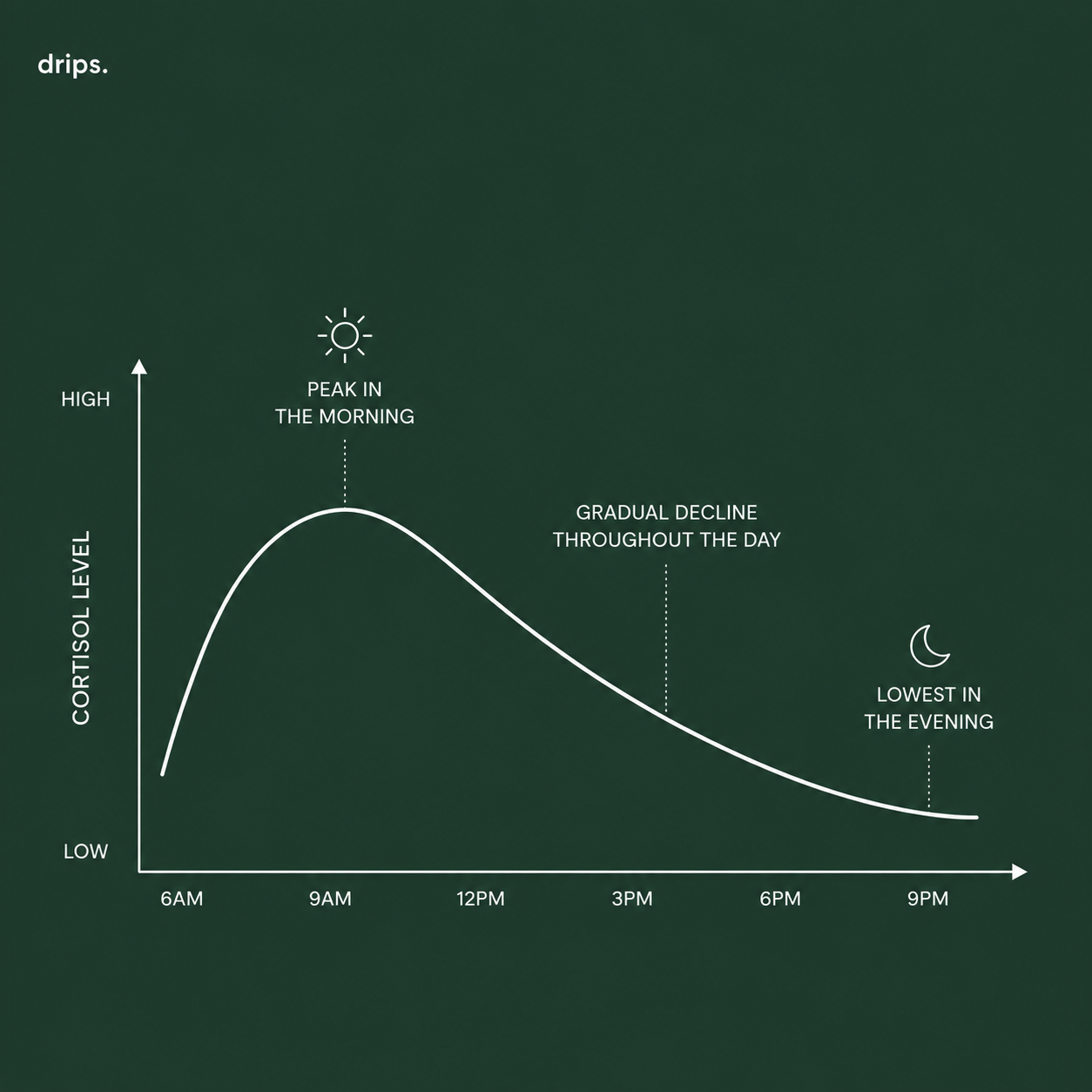
The challenge with cortisol is that it doesn't behave the same way all day. It follows a diurnal rhythm — a natural rise and fall across 24 hours — and disruptions to that rhythm can affect how you feel even when your total cortisol appears within range.
This is why a single cortisol number, taken at a single point in time, can be misleading.
The three things your cortisol results actually measure
1. The daily free cortisol pattern
This is the diurnal curve — a map of how your free cortisol (active cortisol circulating in your body) rises and falls across the day. A healthy pattern typically looks like a peak shortly after waking, a gradual decline through the morning, and low levels by evening and bedtime.
Disruptions to this pattern are clinically meaningful, even when your total cortisol looks normal. Someone who is producing normal amounts of cortisol overall may still have an inverted pattern — low in the morning, elevated at night — which can contribute to symptoms like fatigue, poor sleep, and difficulty managing stress.
What this pattern helps identify: disruptions in the HPA axis rhythm, timing-related issues with energy and sleep, and whether cortisol is peaking at the right time of day.
2. The 24-hour free cortisol total
This is the sum of all cortisol readings across the day — your total exposure to active cortisol in circulation. It tells you how much free cortisol was present in your body on the day of testing.
Here is where a critical distinction becomes clear. Two people can have exactly the same 24-hour free cortisol total and require completely different clinical conversations. One person may have that total concentrated in the morning. Another may show it distributed across the day, with elevated levels at night. Same number. Very different physiology.
This is why looking at the total alone, without the pattern, gives an incomplete picture.
3. Metabolised cortisol (total cortisol production)
This is where many people are surprised. Metabolised cortisol — measured through the metabolites THF and THE in urine — reflects how much cortisol your adrenal glands actually produced on the day of testing, not just what was circulating freely.
Here's why the distinction matters: cortisol in your body exists in an active form (free cortisol) and an inactive form (cortisone). Your body can interconvert between these depending on how much cortisol activity it needs. When the body wants to eliminate cortisol entirely, it converts it into these metabolites, which are then excreted.
By measuring metabolised cortisol, you get a much more accurate picture of adrenal output — how hard your adrenal glands are actually working — regardless of what the free cortisol number showed.
Someone with low free cortisol but high metabolised cortisol, for example, may be producing a great deal of cortisol but clearing it rapidly. Someone with normal free cortisol but low metabolised cortisol may have suppressed adrenal output. These are fundamentally different physiological states.
Understanding cortisol clearance rate
Alongside production and pattern, the rate at which cortisol is cleared from circulation adds another layer of context.
A faster-than-normal clearance rate means cortisol is being metabolised and removed from circulation more quickly than typical. This can be associated with factors such as insulin resistance, certain inflammatory states, or elevated BMI. It doesn't necessarily mean cortisol is "bad" in those cases — in some contexts, faster clearance may be a compensatory mechanism — but it is a signal worth investigating.
A slower-than-normal clearance rate can be associated with hypothyroidism, liver function considerations, or certain other metabolic states. Again, this isn't a diagnosis — it's a piece of information that informs what questions to ask next.
A real-world illustration
Consider two women, both of whom have the same 24-hour free cortisol total. On paper, they look identical.
The first shows cortisol concentrated in the early morning — elevated between waking and two hours after rising, then falling to low levels for the rest of the day. She reports waking unrested and struggling to wind down at night.
The second shows normal morning cortisol but elevated levels in the evening. She reports difficulty falling asleep and feeling wired after dinner.
Same total. Entirely different pattern. And if you only had the total, you'd miss the story entirely.
This is why the combination of pattern, total, and metabolised output — along with clearance rate — gives a fundamentally different quality of information than a single cortisol point.
One more important consideration: timing of testing
Cortisol results can be significantly affected by external factors, most notably the use of corticosteroid medications. Prednisone and other glucocorticoids can suppress HPA axis function and result in cortisol readings that appear severely low — sometimes resembling patterns seen in Addison's disease — even in people who do not have adrenal insufficiency. This is why clinicians reviewing cortisol results always consider the full clinical picture, including current medications, alongside the numbers.
What this means for how you interpret your results
If you've had a cortisol test that returned a single number with a "normal" or "abnormal" flag, you now know why that's an incomplete picture. The pattern of cortisol across the day, the total circulating load, and the adrenal production reflected in metabolised cortisol each tell you something different — and it's the relationship between them that's clinically meaningful.
Advanced hormone testing panels, such as the DUTCH test offered through Drips, are designed to provide this layered picture rather than a single data point. For clients who want to understand their stress physiology, sleep, energy, and hormonal health at a deeper level, this kind of panel forms part of a more comprehensive view.
If you have questions about cortisol testing or would like to discuss whether hormone testing is appropriate for you, a Drips doctor consultation provides a clinical context for your results.
This article is for educational purposes only. It does not constitute medical advice and is not intended to diagnose, treat, or prevent any health condition. Please consult a qualified clinician for personalised health guidance.